


New policy brief: Broadband Affordability and the BEAD Program: Analysis and Policy Recommendations
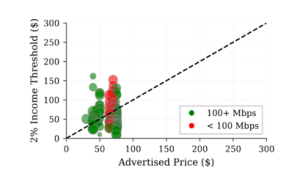 In this new policy brief, Hernan Galperin and François Bar (with co-authors Arpit Gupta, Elizabeth Belding and Laasya Koduru from UCSB) establish comprehensive baseline measurements of service quality and pricing conditions in BEAD-eligible areas, and provide evidence-based insights into how policy changes, demand patterns, and market conditions interact to shape program outcomes. Based on a novel dataset of broadband pricing and service quality data for over 62K unique addresses in four states collected using the BQT tool, the evidence reveals that achieving BEAD’s objective of facilitating access to reliable and affordable high-speed broadband represents a complex challenge. Our findings confirm that, in BEAD-eligible areas, market incentives alone are insufficient to deliver either adequate speeds at affordable prices or affordable services at adequate speeds. The evidence further points to a diversity of baseline conditions across states, suggesting the need for different criteria in the evaluation of BEAD funding proposals as well as different monitoring and evaluation tools. Put differently, while all states are poised to benefit from BEAD investments, the nature of these benefits varies considerably depending on baseline conditions. These variations underscore the importance of state-specific program design that addresses local market conditions rather than applying uniform national standards across diverse geographic and economic contexts. This policy brief is part of the Measuring the Effectiveness of Digital Inclusion Approaches (MEDIA) project (Phase 3) with support from the Pew Trust.